
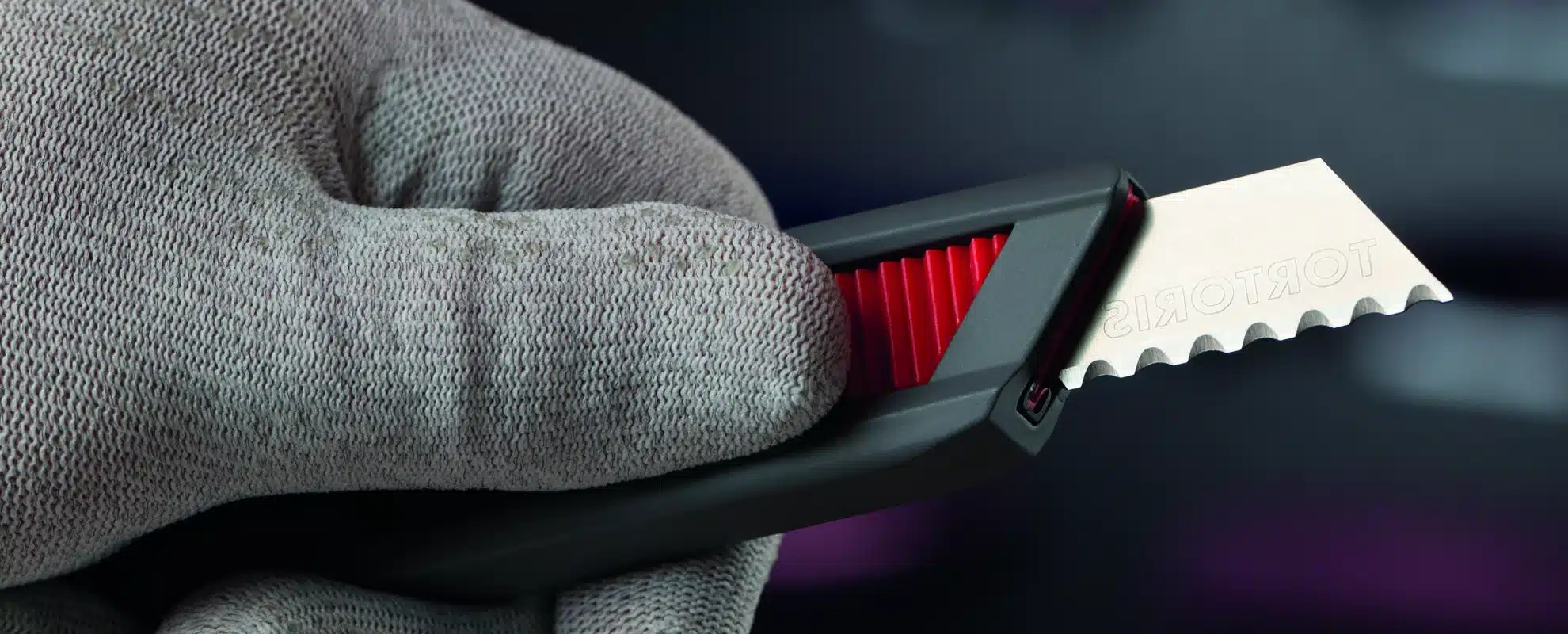
Safety knives for warehousing, logistics and production
Safety knives protect against cuts when opening cartons, film and straps. The range runs from safety knives with automatic blade retraction through fully automatic models and ceramic blades to knives with a protective hook. We compare knives from all the major manufacturers in three safety levels, independent of brand. All prices are in EUR, net, for business customers only; shipping is a flat €14 within Europe and free from €300 goods value.
Sort safety knives by …
Level 1 – safe
The blade springs back as soon as you release the slider. Flexible for almost all cutting jobs – provided the thumb comes off the slider after the cut.
 Safe 10automatic blade retractionCutting depth 21 mmBlade change possible€10.23 excl. VAT
 View US10RECOMMENDEDLevel 1
 VRex 103automatic blade retractionCutting depth 22 mmBlade change possible€13.82 excl. VAT
 View U010RECOMMENDEDLevel 1
 Basic longautomatic blade retractionCutting depth 19 mmBlade change possible€2.99 excl. VATCURTView U013RECOMMENDEDLevel 1
 Safe 24automatic blade retractionCutting depth 18 mmBlade change possible€8.09 excl. VATView US24Level 1
 Secunorm 500automatic blade retractionCutting depth 17 mmBlade change possible€12.47 excl. VAT
 View UM50000110Level 1
 Secunorm 525automatic blade retractionCutting depth 21 mmBlade change possible€12.85 excl. VATView UM525001Level 1
 QBS-20automatic blade retractionCutting depth 14 mmBlade change possible€14.59 excl. VATPHCView U032Level 1
 folding safety knifeautomatic blade retractionCutting depth 19 mmBlade change possible€10.99 excl. VAT
 View U005Level 1
 Comfortautomatic blade retractionCutting depth 21 mmBlade change possible€6.99 excl. VATCURTView U014Level 1
 QuickBack 2 in 1automatic blade retractionCutting depth 76 mmBlade change possible€9.11 excl. VATView U006Level 1
 Safety knife martor Secunorm 300 with trapezoid blade 65232automatic blade retractionCutting depth 17 mmBlade change possible€6.03 excl. VATView UM30000110Level 1
 Profi 25 MDPautomatic blade retractionCutting depth 21 mmBlade change possible€15.05 excl. VATView UM120700Level 1
 SK-12 – detectableautomatic blade retractionCutting depth 14.5 mmBlade change possible€16.37 excl. VAT
 View USK12Level 1
 XDR 610 MDP longautomatic blade retractionCutting depth 32 mmBlade change possible€33.35 excl. VATView UM610001Level 1
 XDR 610 MDPautomatic blade retractionCutting depth 18 mmBlade change possible€33.25 excl. VATView UM610002Level 1
 Secupro Mizarautomatic blade retractionCutting depth 15 mmBlade change possible€10.00 excl. VATView UM125001
 Ergocut miniautomatic blade retractionCutting depth 10 mmBlade change possible€2.99 excl. VATCURTView U019Level 1
 Secunorm 175automatic blade retractionCutting depth 10 mmBlade change possible€4.03 excl. VATView UM175001Level 1
 Basic miniautomatic blade retractionCutting depth 10 mmBlade change possible€1.79 excl. VATCURTView U003Level 1
 Basic mini foldingautomatic blade retractionCutting depth 8 mmBlade change possible€2.40 excl. VATPHCView U034Level 1
 Ergocut mini MDPautomatic blade retractionCutting depth 10 mmDisposable – without blade change€3.99 excl. VATCURTView U19MDP
 Profi longautomatic blade retractionCutting depth 38 mmBlade change possible€13.00 excl. VATCURTView U002PRECOMMENDEDLevel 1
 Safe 23automatic blade retractionCutting depth 60 mmBlade change possible€17.40 excl. VATView USK023RECOMMENDEDLevel 1
 Safe 21automatic blade retractionCutting depth 37 mmBlade change possible€8.99 excl. VATView US21Level 1
 Safe 11automatic blade retractionCutting depth 36 mmBlade change possible€10.23 excl. VATView US11Level 1
 Secunorm 540automatic blade retractionCutting depth 36 mmBlade change possible€14.13 excl. VATView UM54000410Level 1
 Safe 22automatic blade retractionCutting depth 40 mmBlade change possible€17.40 excl. VATView USK022Level 1
 Secunorm 380automatic blade retractionCutting depth 76 mmBlade change possible€14.34 excl. VATView UM380001Level 1
 Profi 40 MDPautomatic blade retractionCutting depth 36 mmBlade change possible€15.91 excl. VATView UM11900771
Level 2 – extra safe
The blade retracts after every cut, even if the slider stays pressed. Strongest with firm materials such as cardboard, board and rubber.
 AS100fully automatic blade guardCutting depth 23 mmBlade change possible€27.85 excl. VAT
 View UAS100RECOMMENDEDLevel 2
 ES44fully automatic blade retractionCutting depth 21 mmBlade change possible€11.26 excl. VATView UES44Level 2
 Secupro 625fully automatic blade retractionCutting depth 21 mmBlade change possible€33.28 excl. VATView UM625001Level 2
 Rebelfully automatic blade retractionCutting depth 17 mmBlade change possible€13.99 excl. VATPHCView UES44RLevel 2
 Megasafefully automatic blade retractionCutting depth 20 mmBlade change possible€20.16 excl. VATView UM116006Level 2
 MartegoCutting depth 9 mmBlade change possible€24.06 excl. VATView UM122001Level 2
 Maxisafefully automatic blade retractionCutting depth 16 mmBlade change possible€12.21 excl. VATView UM10130610Level 2
 EZARfully automatic blade retractionCutting depth 11 mmBlade change possible€7.48 excl. VATPHCView U035Level 2
 RSC432fully automatic blade guardCutting depth 10 mmDisposable – without blade change€6.66 excl. VATPHCView U031Level 2
 Secupro 425fully automatic blade retractionCutting depth 21 mmBlade change possible€20.19 excl. VATView UM425001Level 2
 MerakCutting depth 9 mmBlade change possible€16.90 excl. VATView UM124001
Level 3 – ultra safe
Before, during and after the cut, the blade sits behind the protective hook. Fingers and goods cannot reach the cutting edge.
 CB100concealed bladeCutting depth 7 mmBlade change possible€8.99 excl. VATView HCB100Level 3
 CB100 narrowconcealed bladeCutting depth 5.8 mmBlade change possible€8.99 excl. VATView HCB100-NGLevel 3
 XChange XC-20concealed bladeCutting depth 4.5 mmBlade change possible€9.99 excl. VAT
 View H031OLevel 3
 XChange XC-30 wideconcealed bladeCutting depth 7.5 mmBlade change possible€9.99 excl. VATView H032OLevel 3
 Secumax 350concealed bladeCutting depth 6 mmBlade change possible€9.99 excl. VATView UM350001Level 3
 Secumax 370concealed bladeCutting depth 10 mmBlade change possible€12.60 excl. VATView UM370001Level 3
 Safe 40concealed bladeCutting depth 6 mmBlade change possible€7.16 excl. VATView US40Level 3
 Klever Kutter stainless steel safety knifeconcealed bladeCutting depth 6 mmBlade change possible€19.91 excl. VATView HKS-101SS
 SK-15 yellowconcealed bladeCutting depth 3.2 mmDisposable – without blade change€2.00 excl. VATView H036Level 3
 Ultra Safe 53 redconcealed bladeCutting depth 5.5 mmDisposable – without blade change€2.10 excl. VATView US53Level 3
 Secumax 145concealed bladeCutting depth 3.8 mmDisposable – without blade change€2.25 excl. VATView UM145001Level 3
 Koncept blueconcealed bladeCutting depth 4.1 mmDisposable – without blade change€2.55 excl. VATView H037BLevel 3
 EBC1concealed bladeCutting depth 10 mmDisposable – without blade change€3.28 excl. VATPHCView H046Level 3
 Kutter orangeconcealed bladeCutting depth 3.3 mmDisposable – without blade changefrom €1.96 excl. VATView H035OLevel 3
 Kutter MDPconcealed bladeCutting depth 3.3 mmDisposable – without blade change€3.38 excl. VATView H035MDPLevel 3
 Kutter Kleenconcealed bladeCutting depth 3.3 mmDisposable – without blade change€3.20 excl. VATView H035KleenLevel 3
 BoxCutter Miniconcealed bladeCutting depth 4 mmBlade change possible€9.95 excl. VATView US32
 SK-10concealed bladeCutting depth 3 mmBlade change possible€8.45 excl. VATView H041Level 3
 Secumax 320concealed bladeCutting depth 4 mmBlade change possible€10.24 excl. VATView UM32000110Level 3
 Easysafeconcealed bladeCutting depth 7 mmBlade change possible€12.51 excl. VATView UM121001Level 3
 45-C – rotary cutterconcealed bladeCutting depth 7 mmBlade change possible€19.45 excl. VATView H45CLevel 3
 Film knife martor Snitty with concealed bladeCutting depth 2 mmBlade change possible€4.49 excl. VATView UM43037Level 3
 Secumax 320 MDPconcealed bladeCutting depth 4 mmBlade change possible€11.61 excl. VATView UM32000771
 Paper cutter Miniconcealed bladeCutting depth 2 mmDisposable – without blade change€1.99 excl. VATCURTView H051Level 3
 Film knife mini longconcealed bladeCutting depth 3 mmDisposable – without blade change€1.99 excl. VATCURTView H052Level 3
 Polycut MDPconcealed bladeCutting depth 3 mmDisposable – without blade change€3.03 excl. VATView UM85007
Ceramic – safety blade
The ceramic blade with safety grind cuts the material but barely the skin – even with manual blade retraction. Rust-free, oil-free, spark-free; ideal for sack goods.
 Pen cutter automaticautomatic blade retractionCutting depth 11 mmBlade change possible€12.98 excl. VAT
 View U008Ceramic
 Pen cutter manualManually retractable bladeCutting depth 11 mmBlade change possible€13.29 excl. VATView U011Ceramic
 mini automaticautomatic blade retractionCutting depth 9 mmBlade change possible€8.99 excl. VATView U10514Ceramic
 mini manualManually retractable bladeCutting depth 9 mmBlade change possible€8.99 excl. VATView U10515Ceramic
 Safety Cutter 00200Safety blade made of ceramicCutting depth 2 mmDisposable – without blade change€5.99 excl. VATView S072Ceramic
 Micro ceramic knifeSafety blade made of ceramicCutting depth 2 mmDisposable – without blade change€4.79 excl. VATView SO400
 automaticCutting depth 20 mmBlade change possible€22.52 excl. VATView U10554Ceramic
 manualCutting depth 20 mmBlade change possible€22.52 excl. VATView U10550Ceramic
 Pliers grip fully automaticfully automatic blade retractionCutting depth 20 mmBlade change possible€25.50 excl. VATView U10564Ceramic
 Pliers grip automaticautomatic blade retractionCutting depth 20 mmBlade change possible€24.50 excl. VATView U10563


No knives match this selection. Change filters
Safety knife guide
Safety levels, applications, quality, blade and features – explained independent of the manufacturer.
Safety knives – also called safety cutter knives or cutter knives with safety blade in the trade – are knives that prevent cuts at work.
The most important difference between safety knives is the safety technology: how reliably the knife protects against cuts and against damage to the goods. If you slip while cutting, the blade should hit neither fingers nor arm or thigh.
We carry safety knives from all the major manufacturers. That is why we do not recommend one brand but the knife that suits your application.
Safety levels
Safety knives are divided into levels according to their protective effect. The higher the level, the less safety depends on the behaviour of the user. You will find a detailed explanation of each level on the page The 4 safety levels (in German).
The levels at a glance
| Level | Technology | Protection | Typical application |
|---|---|---|---|
| Level 0 | none – fixed blade or manually retractable | no protection | Cutter knives, carpet knives – only where no safety knife is possible |
| Level 1 | automatic blade retraction | Blade springs back as soon as the slider is released | almost all cutting jobs |
| Level 2 | fully automatic blade retraction or ceramic safety blade | protects even if the slider stays pressed | Cardboard, board, rubber, sack goods; from approx. 200 cuts per day |
| Level 3 | concealed blade with protective hook | Blade concealed before, during and after the cut | Film, straps, sacks, cardboard (BoxCutter) |
Level 0 – no protection
Level 0 knives have no protective mechanism: no automatic blade retraction and no concealed blade. Typical are
- snap-off blades with predetermined breaking points that break more easily,
- manual blade retraction – the user has to retract the blade themselves,
- fixed blades that cannot be retracted into the handle.
From an occupational safety point of view, these knives are problematic. They belong only where it is ensured that no part of the body comes into contact with the blade – then additionally with cut-resistant gloves. You will find cutter and carpet knives in the cutter knife guide.
Level 1 – automatic blade retraction
As soon as the user releases the slider or lever, a spring pulls the blade back into the handle after the cut. The risk of a cut injury drops considerably.
- No snap-off blades – no blade breakage at predetermined breaking points
- Automatic blade retraction – the blade does not stay open by accident
- Operation counts – only when the thumb releases the slider does the blade spring back
The protection requires the user to use the technology: if you hold the slider pressed, you keep cutting with an open blade. That is why level 1 knives are very flexible, suit almost all applications and are readily accepted – the switch from a cutter knife is easy.
Level 2 – fully automatic or ceramic
Level 2 knives protect even when the user is not actively paying attention to safety. Two technologies achieve this: the fully automatic blade retraction (around 80 % of the knives at this level) and the ceramic blade with safety grind (around 20 %).
With fully automatic blade retraction, the blade retracts into the handle after every cut – even if the slider stays pressed.
- No snap-off blades – stable cutting without blade breakage
- Fully automatic blade retraction – independent of the user’s behaviour
- Pliers grip (on some models) – for high cutting volumes
This level is particularly suitable for cardboard packaging and firm materials – in warehouse logistics, production and packaging. From about 200 cuts per day and knife, a pliers grip noticeably relieves the hand. In returns departments, our customers cut more than 10,000 cuts per shift and knife.
Ceramic safety blades are not as sharp as metal blades; the cut takes more force. That is exactly what lowers the risk of injury if the knife slips. Despite the lower sharpness, they cut almost all materials. For sack goods they are ideal: they offer high safety even with manual blade retraction, and hardly any dirt gets into the housing while cutting.
Level 3 – concealed blade
A protective hook sits in front of the blade before, during and after the cut. The cutting edge is not freely accessible – even if you slip. Fingers and goods cannot reach the blade. Wherever the application allows it, this level is the first choice.
There are two designs:
- BoxCutters also cut cardboard, corrugated board and board. The blade head is shaped so that you pierce, pull and cut – without changing grip.
- Film knives cut film, stretch film, paper and strapping, but not cardboard. Their nose in front of the blade is usually a little longer than on a BoxCutter, so they glide more easily through film.
Application – what do you need to cut?
Which safety knife fits is decided mainly by the material. The overview shows the most common cutting jobs in warehousing, logistics and production and which design has proven itself for them.

Cardboard and board
Opening boxes of one- to three-ply corrugated board and cutting their flaps and tape seams. For everyday use level 1 with approx. 2 cm cutting depth; if you cut a lot, choose fully automatic; BoxCutters also cut cardboard with a protective hook.
Carton knife guide →
Adhesive tape
Slitting adhesive tape on the carton without hitting the contents. Little cutting depth is enough: mini knives, BoxCutters or a knife with a tape slitter.
Mini safety knives →
Straps and strapping
PP and PET strapping of any width. Safest with a protective hook: film knives and BoxCutters pull the strap into the hook and cut it there.
Film knives →
Film and paper
Stretch film, shrink film, paper. Film knives with a long nose cut most easily here; fully automatic knives are less suitable for thin film.
Film knife guide →
Bags and sacks
Shipping bags, paper and plastic sacks. Ceramic safety blades with manual retraction are ideal for sack goods – hardly any dirt gets into the housing.
Ceramic safety knives →
Roll goods
Paper and film rolls: separating layers, joining splices. What is needed is sufficient cutting depth and a stable blade.
Long safety knives →
Stripping off remnants
Cutting off remaining layers of paper, film and plastic rolls down to the core. A long, robust blade counts here.
Long safety knives →
Rubber and heavy duty
Rubber sheeting, PVC, thick film: hard materials. The harder the material, the stronger the case for fully automatic blade retraction.
Fully automatic safety knives →
Deburring
Deburring plastic parts – a job for a scalpel and deburring tool with a fine, pointed blade, not for the safety knife.
Scalpels and deburring tools →
Building services
Cables, boxes, cords and much more. For changing tasks, a standard safety knife with approx. 2 cm cutting depth is the flexible choice.
Standard safety knives →
Scraping
Removing labels, paint residues, adhesive residues – with a scraper rather than with the blade of the safety knife.
Scrapers →Quality of a safety knife
How good a safety knife is shows in continuous use: in the material and workmanship of the housing, in the ergonomics and in the blade. Which quality you need depends mainly on how often you cut – in logistics warehouses, stores and production a robust knife quickly pays off, while for few cuts a simpler model is enough.

Housing material
- Plastic – simple polypropylene (PP) is inexpensive but not very robust and wears faster. Sufficient for occasional use.
- Glass-fibre-reinforced plastic – considerably more stable and more resistant to impact and abrasion; for regular use.
- Plastic with metal – plastic handle with a sheet-metal or steel rail: solid stability.
- Metal handle – aluminium, zinc or magnesium offer the highest stability and a long service life.
Ergonomics
- Slider – easy to reach, smooth-running, non-slip even with damp hands.
- Handle shape – a handle that adapts to the hand reduces fatigue.
- Non-slip surface – extra grip when hands are damp or oily.
- Blade change without tools – faster and safer.
- Right- and left-handed users – symmetrical handle or double-sided slider.
GS mark
The GS mark (“Geprüfte Sicherheit”, tested safety) is a voluntary German test mark under the Product Safety Act. An approved test body tests a type sample and then monitors production. The mark certifies compliance with the safety requirements – in other words a minimum level of safety. It says nothing about quality, ergonomics or edge life.
How often is it used?
In retail, in stores, in the logistics warehouse or in the returns department, mostly cartons, film and strapping are opened. In a mid-sized goods-in area it is usually 500 to 1,000 cuts per day and knife. In production, sacks, octabins, film bundles or cartons of raw materials are opened – often in damp, dusty or sub-zero conditions.
Occasional
A few cartons in goods-in, occasionally adhesive tape or film. A solid plastic knife is enough here – what matters are the right safety level and a fixed place for the knife.
Basic miniautomatic blade retractionCutting depth 10 mmBlade change possible€1.79 excl. VATCURTView U003Koncept blueconcealed bladeCutting depth 4.1 mmDisposable – without blade change€2.55 excl. VATView H037BSecumax 145concealed bladeCutting depth 3.8 mmDisposable – without blade change€2.25 excl. VATView UM145001Frequent
Goods in, order picking, store: 500 to 1,000 cuts per day and knife are usual. Glass-fibre-reinforced plastic, a smooth-running slider and easy blade changes make the difference here.
Ergocut miniautomatic blade retractionCutting depth 10 mmBlade change possible€2.99 excl. VATCURTView U019ES44fully automatic blade retractionCutting depth 21 mmBlade change possible€11.26 excl. VATView UES44Secumax 350concealed bladeCutting depth 6 mmBlade change possible€9.99 excl. VATView UM350001SK-10concealed bladeCutting depth 3 mmBlade change possible€8.45 excl. VATView H041Intensive
Logistics centres and returns departments: our customers cut more than 10,000 cuts per shift and knife. Metal housing, pliers grip and high-quality blades pay off quickly here.
Safe 10automatic blade retractionCutting depth 21 mmBlade change possible€10.23 excl. VATView US10Secupro 625fully automatic blade retractionCutting depth 21 mmBlade change possible€33.28 excl. VATView UM625001CB100concealed bladeCutting depth 7 mmBlade change possible€8.99 excl. VATView HCB100Secunorm 175automatic blade retractionCutting depth 10 mmBlade change possible€4.03 excl. VATView UM175001Blade
The blade decides whether the knife cuts easily and how long it stays sharp. Here is the short version – all replacement blades, fits and background are in the cutter blade guide (in German).
Blade shapes

The blade for safety and carpet knives. Two corners; it is turned when one gets dull.

9, 18 or 25 mm wide. When the tip is dull, a segment is snapped off.

Long and without snap-off segments – for deep cuts in foam and insulation.

Fine and pointed – for deburring and precise contours.

Usually made for one specific knife – they only fit that handle.
Initial sharpness and edge life
Initial sharpness
How easily a new blade cuts. It drops from the first cut – most strongly right at the start. A high initial sharpness alone says little about quality.
Edge life
How long the blade keeps a minimum sharpness with which you can cut your material without too much force. From our customers’ practice: with high-quality blades, over 2,000 cuts per blade side are possible in abrasive corrugated board, while poor blades sometimes tear the material after fewer than 300 cuts.
Material

Carbon steel
The standard, e.g. SK5 – carbon ≤ 1 %+sharp, inexpensive, easy to sharpen
–rusts in damp conditions
Use Cardboard, film, warehouse and shipping

Premium carbon steel
e.g. SK2 – carbon over 1 %, higher hardness+keeps its sharpness considerably longer
–somewhat more expensive
Use where a lot is cut every day

Stainless steel
From 10.5 % chromium low-rust+corrosion-resistant
–basic grades are softer
Use Moisture, food, pharma

Ceramic
Zirconia with safety grind+rust-free, oil-free, spark-free, non-magnetic
–brittle, must not be tilted; less sharp
Use Safety, food, electronics
Special features
Small details decide in everyday use whether a safety knife is gladly used.

Transport lock
Locks the slider so that the blade does not extend accidentally. Important if the knife is carried in a pocket rather than in a holster.

Eyelet
For a lanyard or workstation – almost every safety knife has one. The size differs: not every hook fits every knife.

Fin
A blunt metal spike for scoring adhesive tape without extending the blade.

Spacer
Limits the cutting depth and protects the goods – especially when opening cartons in the bulk warehouse.

Magnet
Holds the blade in place during the change, even if the knife is turned upside down.

Soft grip
Two-component (2K) handle: slips less and feels more comfortable in the hand – even with a glove.
Safety knife manufacturers
We carry safety knives from the most important manufacturers and recommend regardless of brand. For seven brands there is a dedicated page with the full range and the matching blades.

 Manufacturer page
Tortoris
Safety knives with automatic blade retraction and matching replacement blades – sorted by safety level and cutting depth.
To the manufacturer page →
 Manufacturer page
martor
Safety knives from Solingen by safety level, detectable MDP models and film knives – with an overview of which blade fits where.
To the manufacturer page →
 Manufacturer page
Slice
Safety knives with ceramic blade – compact, standard and long – plus scrapers, seam rippers, deburring tools and all matching blades.
To the manufacturer page →
 Manufacturer page
Klever
Safety knives from the USA with a protective hook in front of the blade – XChange with replaceable blades, Kutter as disposable, plus Kleen antibacterial and MDP detectable.
To the manufacturer page →
 Manufacturer page
OLFA
Cutter knives in 9, 18 and 25 mm, rotary cutters, safety knives and scalpels from the inventor of the snap-off blade – with all matching blades.
To the manufacturer page →
 Manufacturer page
RiteKnife
Safety knives with concealed blade and fully automatic retraction, plus scrapers, precision knives and blades from Mozart.
To the manufacturer page →
 Manufacturer page
Tajima
Cutter knives, safety knives, carpet knives and scrapers from Japan – with matching blades and accessories.
To the manufacturer page →Stanley
Besides cutter and carpet knives, the US tool manufacturer also offers safety knives with automatic blade retraction. Stanley knives →
PHC – Pacific Handy Cutter
The US manufacturer has a broad range for opening packaging – with many models with a spacer for opening cartons. PHC safety knives →
Frequently asked questions
What is a safety knife?
What is the difference between a cutter knife and a safety cutter knife?
What do WAK, WUK and VLK mean?
What can you cut with a safety knife?
Which safety knives are suitable for heavy industrial use?
What does the GS mark mean on safety knives?
How safe are ceramic blades compared with steel blades?
How do you convince employees to switch to safety knives?
- Take the time to define the requirements for the knife precisely.
- Test several knives on your real cutting tasks with our field service or free test samples.
- First let a few motivated employees work with the new knives for a few weeks – they become multipliers.
Is there an obligation to use safety knives?
Employee and goods protection
Cuts and stab wounds are among the most common causes of accidents. According to BG RCI (German statutory accident insurance), in the plastics industry one in five accidents results in a cut injury to the hand, and in upholstery trades even one in three; 82 % of cuts and stab wounds affect the hand (BG RCI, Kurz & Bündig KB 014, edition 1/2024, in German). Safety knives are one of the simplest measures against this – and they also protect the goods.
Accessories
Safety in the workplace is an overall process. It is not enough to improve only the cut itself – the steps before and after matter too. Where does the knife lie before and after the cut? Is it attached to a lanyard? Is it in a trouser pocket or in a holster? How and where is the blade changed?
Many of our customers change blades at a central point. The dull blades go into a collection box where nobody can get hurt on them any more. If users change blades themselves, a small blade box belongs in their kit. For a cutting ruler, a hardened cutting edge with a finger guard is worthwhile.


Which safety knife suits your business?
We work independent of the manufacturer and send you free test samples for your real cutting tasks. For the consultation we ask you:
- Which knives do you use today – cutter knives, carpet knives or already safety knives?
- What do you need to cut, and how often per day?
- Is there a requirement from a risk assessment, audit or the statutory accident insurance body?